- info@wildlife-removal.com
Call us for help in your town
Wildlife Removal Education
Bats in the Attic
Need bat removal in your hometown? We service over 500 USA locations! Click here to hire us in your town and check prices - updated for year 2020.
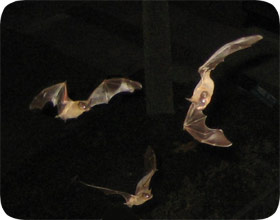 Ah, bats in the attic. This is one of the more serious and complicated problems in the field of nuisance wildlife control. You must follow these steps:
- Determine the Species of Bat
- Make Sure There Are No Baby Bats!
- Find Out How They Are Getting In / Out
- Safely Remove the ENTIRE Colony
- Seal up 100% of the Openings
- Clean Up the Guano Droppings
How to Get Rid of Bats in the Attic: The process
is definitely not simple. In a nutshell, you
have to find out how they are flying in and out,
install a special one-way device (there are
several different types, for different
scenarios) over the exit area, and let them fly
out, but not fly back in. And you MUST NOT do it
when there are baby bats present, or you will
have a big problem. Plus you'd be breaking the
law, but that's the least of your concerns,
compared to potentially hundreds of stranded
baby bats now crawling down your walls, into
your house, and eventually dying and rotting & stinking. The process is complex, because bats can enter such tiny areas, about 3/8 inch. You must do a 100% effective sealup job, with no mess-ups, and the exclusion devices must
be the correct kind. If on an eave gap, a funnel is correct. If across a large fascia board, polynet is correct. Etc. Experience is very important when it comes to bat jobs.
Click here to hire us for bat removal in your town. I do actually recommend that you hire a professional with bat removal experience for getting rid of bat problems. I myself
trained for two years with a bat removal expert before I started my own bat removal jobs, and even then, I had a lot to learn. If you mess it up, you've got a big problem on your hands.
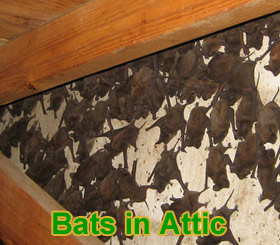 Bat colonies want to roost in a safe place - a cave, for example. But the attic of a home will do quite nicely. Is it common for bats to get inside the living areas of a home? The colonies of bats are usually composed
entirely of female bats, and are called a maternity colony. The female bats usually give birth to one baby bat each summer. Thus, the colony size roughly doubles at birth, and when the baby bats start to fly, you notice twice as many bats. Bats live a very long time, and
they stay in the same place year-round, conditions permitting, or they migrate and return each summer. Thus, with time, bat colonies can grow to enormous sizes.
A fully infested bat attic is one of the biggest and most challenging problems
in the field of problem wildlife removal.
Bat colonies want to roost in a safe place - a cave, for example. But the attic of a home will do quite nicely. Is it common for bats to get inside the living areas of a home? The colonies of bats are usually composed
entirely of female bats, and are called a maternity colony. The female bats usually give birth to one baby bat each summer. Thus, the colony size roughly doubles at birth, and when the baby bats start to fly, you notice twice as many bats. Bats live a very long time, and
they stay in the same place year-round, conditions permitting, or they migrate and return each summer. Thus, with time, bat colonies can grow to enormous sizes.
A fully infested bat attic is one of the biggest and most challenging problems
in the field of problem wildlife removal.
How Do You Get Bats Out of the Attic? - The best tool is education. Here are tips about bats in the attic:
TYPE & TIME OF NOISE: Bats are nocturnal, but they are pretty quiet in small numbers, and most people don't notice any noise. However, a large swarm of thousands of bats makes a hell of a ruckus, what with the crawling and flying and squeaking of the whole bunch. Sometimes people will hear them rustling and fluttering above the ceiling or in the walls. The best chance of hearing them is at dusk, as they are lining up to fly out of the house.
HOW THEY GOT INSIDE: Bats can squeeze through extremely small gaps - 3/8 of an inch. They like to fly into homes at small architectural gaps near the edge of the roofline, usually. From there, they crawl to their roosting spots. It's often easy to spot where they are going in and out, because they leave brown staining from the grease and oil in their fur, at the entry point. Or, you an just watch the house at dusk and see where they are coming out. It might be several different areas of the home.
EVIDENCE LEFT BEHIND: Although physical sightings of them entering and exiting the building are the best identifier, bats clearly make themselves known with the odor of their droppings, or guano. It can accumulate in huge amounts, contaminating an attic and potentially causing lung disease for the people in the house. Read more about All the Ways that Bats Can Cause Damage in your Attic.
TIME OF YEAR: If the attic is warm enough, year round. Otherwise, they migrate and return each spring. Many bat problems happen when the young start to crawl around and fly, and sometimes the inexperienced young crawl down into the house. This usually happens in the month of August, which is the high season for bat control work.
METHOD OF CONTROL: Mothballs or ammonia won't make them leave, nor will ultrasonic sound emitters or strobe lights. These tactics have been ruled fraudulent by the FTC, and they DO NOT WORK. The bats must be removed from the attic, and they are protected as colonies, so they must not be killed. You don't want to kill a beneficial bat anyway. The bats are usually excluded through one-way exclusion devices. Sealing the building properly is critical to the process.
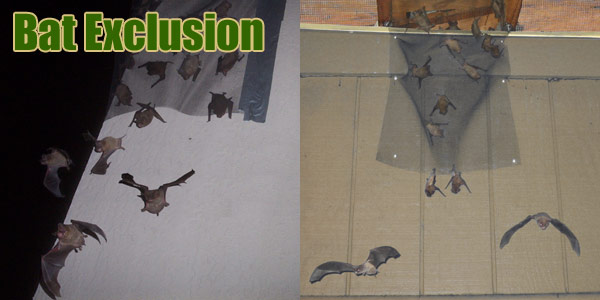
Here we see photos from two different bat jobs. I've isolated the colony to the most common exit hole, by sealing off all other exits, and installed one-way exclusion netting. This has to be set just right, with ample room for the bats to be able to drop out at the top, and clear the bottom, but not be able to fly back in. It's very precise, and it takes practice.
The bottom line is that bat control is often a very difficult task that requires professional attention and the experience of a wildlife control pro who has done several complete bat jobs.
You must always be aware of the possibility of baby bats in the attic, during the summer bat maternity season, usually from mid-May until mid-August in North America. Read about Are there bat babies in my attic? You must never do a bat exclusion during these summer months, because you will kill all the young flightless bats inside if you strand them from their mothers who give them milk.
Customer Email:
Very impressive site David.....I have respect for what you do. I am living in Southern California and was looking for someone to do what you do - for bats to be specific. I need to get rid of bats in my attic. My studio mate yesterday removed the bat from our studio (safely he claims) but i still had a few concerns i wanted to ask you about i you have a brief moment to look at. The bat entered ( I believe ) through a rotating vent on the roof the other night while i was working in my upstairs office lighted to probably attract my visitor. I herd some chirps then saw him fly very closely by my head. I ran as people do and proceeded to work on a removal plan..but gave up after an hour or so and left it to the next day for my studio mate. In the process that night I had him fly close to me...not seeing him at all times and then reappear...I noticed upon a hyper exam the next day a couple little fresh marks on upper back...probably from something else like backpack I was wearing..but not sure. I am sure that even though he was not insight at all times I would have felt a stick ( I hope)...also I looked up at him a couple times almost directly above me roosting on a rafter and felt ( perhaps imagined ) a drop or two on the face...could that be saliva? Obviously an over concerned nut but would love your opinion. The bat is no longer avail. Thanks David, John
It turned out in this case that John had a colony of bats living in his attic, and one crawled down and did get through either a vent or a different gap leading from the attic to the house. It wasn't just an isolated incident, as people often assume is the case, because bats can be very quiet, and people often don't know that there's a group of them living up in the attic, until they've caused a very big problem. I referred John to my bat specialist in his area of San Diego, and he got his problem professionally taken care of, and his attic cleaned properly.
I have written several other detailed articles:
How to get bats out of the house
How to get bats out of the chimney
Bat exclusion tips and techniques
Bat trapping
How to catch a bat
How to inspect your house for bat entry
Bat prevention methods
Are Bat Houses Really Effective in Preventing Bats in the Attic?
The Five Ways of Getting Bats Out of a Wall
Should I ever poison a bat?
The author, David, is a bat removal expert with over 500 successful bat control jobs under his belt. Who will help me with a bat colony in the attic? I want to stress the importance of proper bat removal, and the value of these animals to the ecosystem. I've witnessed dozens of failed do-it-yourself bat jobs over the years, and it is not pretty - dead bats, horrible odors, rabies vaccinations, and so on. Bat removal work is not easy - I trained for two years learning, and even then, it took many jobs and hands-on training before I was competent. I highly recommend that you consult my list of wildlife control companies on the home page, and hire a professional to come out and look at your bat problem. Get a few quotes if you must. And remember, do not perform any bat exclusions during the summer maternity months. For more general information and links, go to my main bat removal page.
We now service over 500 locations! Click here to hire us for wildlife removal in your town.
How to Get Rid of Bats in the Attic - When it comes to animals that are beneficial to have living in your area, bats are actually one of the friendliest creatures as they are insectivores, and will come out around dusk to hunt flying insects such as mosquitoes and gnats. However, when the bats decide to get a little more friendly and actually move in to the attic, they can cause a few more problems. One of the biggest problems is that they do produce a lot of guano, bat droppings, and this can be harmful to people and will need to be cleaned and disinfected.
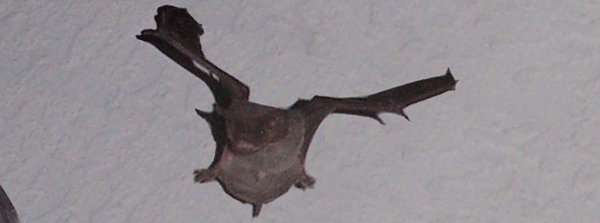
Can You Trap Bats?
The first instinct of many people who are dealing with an animal problem is to use cage traps and then relocate the animals, but this is an approach that doesn't really work successfully with bats. The reason for this is that bats fly using echolocation to decide their route, but this doesn't pick up wire mesh well enough, which confuses the bats. The result of using a cage to trap bats will end up with many of the bats repeatedly flying into the walls of the cage, which is really very harmful to the bats and can even kill them.
Bat Exclusion Methods
Exclusion is the best way of dealing with a bat infestation, but firstly you need to make sure that you have the right equipment, and a breathing mask and goggles will help to protect you from airborne particles when the guano is disturbed. Exclusion work will effectively require you to examine the attic, and find all the spots the bats are using to get in and out. You then install an exclusion funnel or exclusion netting over one or two of these holes, and then seal the remaining holes.
It may be worth installing bat boxes on trees or poles around your property where the bats can roost, and this will allow you to keep the beneficial aspects of having bats in your neighborhood.
Sealing And Repairing The Attic
The bats will leave the attic over the next two or three days, but will not be able to find their way back in. Once you can see there are no bats remaining in the attic, seal the remaining holes and remove the exclusion devices. You will then need to carefully remove and dispose of all the guano, and then use a fumigant to disinfect the attic before it is safe to be used again.
Select Your Animal

RaccoonsRaccoon Removal Information & How-To Tips

SquirrelsSquirrel Removal Information & How-To Tips

OpossumOpossum Removal Information & How-To Tips

SkunksSkunk Removal Information & How-To Tips

RatsRat Removal Information & How-To Tips

MiceMouse Removal Information & How-To Tips

MolesMole Removal Information & How-To Tips

GroundhogGroundhog Removal Information & How-To Tips

ArmadillosArmadillo Removal Information & How-To Tips

BeaverBeaver Removal Information & How-To Tips

FoxFox Removal Information & How-To Tips

CoyotesCoyote Removal Information & How-To Tips

BirdsBird Removal Information & How-To Tips

BatsBat Removal Information & How-To Tips

SnakesSnake Removal Information & How-To Tips

DeadDead Animal Removal Information & How-To Tips

OthersOther Wildlife Species Information & How-To Tips