- info@wildlife-removal.com
Call us for help in your town
Wildlife Removal Education
Squirrel Removal and Control
Need squirrel removal in your hometown? We service over 500 USA locations! Click here to hire us in your town and check prices - updated for year 2021.
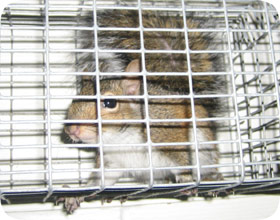 Squirrels are usually classified as a pest species due to their habits of living in houses. The most common complaints include the following:
- Squirrels living in the attic
- Squirrels living in the chimney
- Squirrels chewing on woodwork
- Squirrels stealing bird seed
- Loose squirrel stuck inside home
Since it's a very common problem, I wrote an advice article on how to get squirrels out of the attic with photographs and step-by step instructions.
SQUIRREL BIOLOGY: (Sciurus carolinensis) Squirrels are usually gray, sometimes red, brown, or black. Adults average about one pound in weight. They can supposedly live for up to ten years,
but life expectancy in the wild probably isn't more than 3-4 years. Squirrels give birth to two litters per year - one in late summer, and one in winter. The female gives birth to 3-4 young after a 44 day gestation, and
the young grow quickly, and are weaned in about ten weeks. Read more about what to do with orphaned squirrels.
SQUIRREL BEHAVIOR: Squirrels are most active in morning and evening. Squirrels eat mostly nuts and seeds. They live in a variety of habitats, both forest and suburban or city areas. They establish home
territories, and often communicate via scent, chattering, and flickering of the fluffy tail.
NUISANCE CONCERNS:
Squirrels love to live in attics. They also love to chew, and will chew on houses or wires, ducts, pipes once inside an attic. People don't like the noises of squirrels running about above the ceiling or in the eaves,
but it's really the chewing that's a problem. If squirrels chew on electrical wires in an attic, it can create a real potential fire hazard. Squirrels also bring in nesting material and leave urine and feces in
an attic. They also commonly nest in a chimney, where they can sometimes get stuck and frantically scratch, or sometimes even get into the fireplace
and inside the house. You can read this page, or my more advanced ten-step guide on my How to Get Rid of Squirrels page.
SQUIRREL DISEASES: No real important diseases, though they do carry parasites, and thus are vectors for the diseases that fleas, ticks, etc can transmit. They also leave a lot of droppings, which pose
the usual excrement health risks, such as leptospirosis or Salmonella. Click here for photos of squirrel poop or read the guide A List of Squirrel-Borne Diseases
HOW DO I GET RID OF SQUIRRELS?
If it's just squirrels on the property, the best bet is trapping and removal. If it's squirrels in the attic, then all of the open holes and vulnerable areas through which they can enter should be sealed shut with a
material that squirrels can't chew through, such as steel. The squirrels can then be trapped and removed, or excluded through the use of one-way exclusion doors and tunnels.
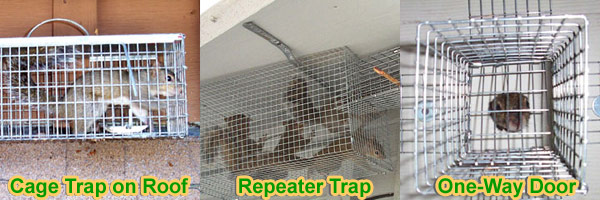
To learn how to do it right, please read my squirrel trapping guide.
Read how to get squirrels out of a house using a one way door.
CAN'T I JUST USE A REPELLENT?
There is no registered or effective squirrel repellent available. You can find some products on the market, such as mothball-based or urine-based repellents, but they are bogus. Go ahead and try them. And those high-pitch
noisemakers? The FTC has issued a warning against them - ultrasonic sound emitters do not work. Some people put noisy radios or strobe lights in the attic, but these also prove ineffective. There is no quick and easy
fix when it comes to squirrel removal and control. It's best to have a professional trap and remove the animals properly. Read my squirrel repellent analysis of whether it works or not or the guide Will City/County Animal Services Remove Squirrels?
CAN I USE A SQUIRREL POISON?
No. Again, there is no registered or effective poison for squirrels. Many people attempt to use rat poison, but squirrels will almost never eat rat poison. And if they do, they don't usually die. And if they do die,
then they're going to die in the attic or walls most likely, and cause a terrible odor as they rot. The smell can last almost a month. Read more about how to find a dead squirrel or
how to kill squirrels and the drawbacks of poison and about other lethal control methods. Some people are curious about the dangers squirrels may pose.
ARE THERE EFFECTIVE SQUIRREL PREVENTION METHODS?
Yes. You can keep squirrels away, and out of your house, with a variety of techniques. For property matters, don't leave out things that attract them, such as easily accessible bird feeders, fruit trees, etc. If
you really want to take it far, cut down all your trees! But more importantly, to keep them away from your house, you must find and seal all open holes that lead inside, to the attic. Read more about it
on my how to keep away squirrels prevention techniques page, or my other Squirrel Prevention Tips page which focuses on physical
deterrents to keep them out of house or garden.
Phoenix Squirrel Control -
Los Angeles Squirrel Control -
San Diego Squirrel Control -
San Jose Squirrel Control -
Denver Squirrel Control -
Orlando Squirrel Control -
Miami Squirrel Control -
Jacksonville Squirrel Control -
Atlanta Squirrel Control -
Chicago Squirrel Control -
Baltimore Squirrel Control -
Boston Squirrel Control -
Minneapolis Squirrel Control -
Charlotte Squirrel Control -
Portland Squirrel Control -
Philadelphia Squirrel Control -
Houston Squirrel Control -
Seattle Squirrel Control
Squirrel Email From Reader: Hi David, Hope you can help. A squirrel tried to get into my soffit or attic. I called some good professionals, they put in a one way door trap.
The squirrel left. All the corners of my house were sealed with a stainless wire mesh doubled. The squirrel has been working on that wire to get into another corner. This started
the first week in December, and probably before she had any babies. Now some six weeks later, she comes to my attic, makes a lot of noise trying to rip up the steel mesh. I bang on the
windows, and I see her go back down. It's the same squirrel, I'm pretty sure. She's now larger, and probably ready to give birth. She takes the same path, over a fence and climbs up
the brick wall of my home. The company I used has come down several times, and even added another layer of wire. So far, she has not gotten in, but she's determined. How can I stop this?
The corner is over my bedroom, and she's coming by at about 8 a.m., and I hear her making a racket when she's working on ripping out the wires. We've been in the attic, and there is no nest, no babies, no smell. So, she hasn't succeeded yet. Thank you.
My Response: If your house was properly sealed by the wildlife company, she won't be able to get in, and she'll have to find another spot. If she's chewing on wood, spray Ropel or hot sauce on those areas to discourage it. It sounds as though
this particular squirrel has become urbanized - it knows of no other place to have young than inside an attic. What happened to good old-fashioned trees?
Squirrel Email From Reader: When is the best time (i.e., what time of year) to catch and relocate squirrels? I trapped and relocated 3 squirrels last summer (after they figured out how to get the food
out of the bird feeder). We now have 3 new squirrels sitting on our deck eying the bird feeder, trying to figure out how to get to it. It is only a matter of time before they are up on the feeder. I want to trap
them (with my very own "Have a Heart" trap the I got for Christmas) and relocate them. But I think right now is not a good time. They have their stash of food for the winter, and if I move them now, what will they have to
eat? If I wait until spring, and they have babies, what will happen to the babies? Do I need to wait until summer? I just want to relocate them, not harm them. What do you and your colleagues think? Thanks. Lenny
My Response: Interesting question. Squirrels are territorial, and I think relocation is a bit hard on them at any time. They have babies twice a year. The food stored in the ground for the winter? - They don't
retrieve it by memory, but by smell. Yes, squirrels steal each others' nuts. I guess the best times to relocate are any month except September or March, when the young are newborn.
How-to guide: how to catch squirrels methods to catch them safely
Photos of squirrel tracks for identification purposes.
Tips on handling squirrels safely
How To Get Rid Of The Eastern Gray Squirrel In Your House -
If you learn that you have squirrels in your house, you will certainly want them gone as quickly as possible. They can be dangerous by spreading disease through their droppings. They leave debris in your house and nasty smells. They also do a fair amount of damage by chewing through electrical wires. It is not an easy task to get rid of them. They like living in peoples homes because thats where the food and shelter is. It is also the place where they can give birth and raise their young in a fairly protected manner.
The only truly effective way to extricate them from your home is to trap them or to create a path of escape. Be careful not to be bitten and be quick to shut doors to rooms further in the home and leave as many exits out of the home open as possible. Dont panic and try to calmly herd the squirrel out of your home. Depending on how the squirrel got into your home you may need to do a few repairs to keep them from entering again. If they entered through an open window it may be as simple as getting a screen. If there is a bit of difficulty you should consult a wildlife specialist.
How To Get Rid Of The Eastern Gray Squirrel In Your Walls -
If you hear squirrels in your walls, this is particularly annoying and also quite disconcerting. You may always wonder when the squirrels are going to try to gnaw their way into your bedroom or the extent of the damage they may be doing. They need to be removed from your walls, pronto! This will not be an easy task by any means. In fact, depending on how resourceful you are in animal trapping, this may not be the job for you but for the seasoned professional. Someone familiar with sheet rock may be able to devise a plan to get the squirrels out of the wall, while someone lacking in home repair skills may need assistance.
If you do want to get the squirrels out from the space between the walls yourself, you may have to cut a hole into your wall after you find the exact area where the squirrel is residing. Cut a square hole into the sheet rock but have a trap placed against the opening before you remove the square you cut. This has to be done carefully so the squirrel wont be able to escape between trap and wall into the house. Once the squirrel is in the trap, take it far away and let it go. Then repair your wall.
How To Get Rid Of An Eastern Gray Squirrel In Your Roof -
Your first indication that you have an animal living in your roof may be the noise it makes when it moves in the rafters. If it has been there for a while, you may get a smell of urine and feces, especially in hot weather. There is no question that you need to have it removed from your house. The only question is how to get rid of it. You may get all kinds of advice from everyone you ask about this. Most information is well meant but useless. Strobe lights have been called a great exterminator of squirrels and there are instances where this method is quite successful.
Powerful smelling deterrents such as ammonia or items you may find in the garden center of your local department store are also worth a try. To use something like this you will want to place the foul smelling substance around everywhere but the exit/entrance hole. This will induce the squirrel to move away from the harsh smells to the outside. Once this is done you can cover their doorway and have a squirrel-free roof. To prevent their re-entrance inspect your roof for any areas they may be entering your home and fill these in.
Everything You Need to Know about Squirrels
When in battle, knowing as much as you can about your opponent will make life much easier when it comes to defeating them. When your opponent is a wild animal, such as a squirrel, knowing as much as you can about it will definitely help to swing things in your favor. The more you know, the more you can predict. Just think of it like one big battle of chess.
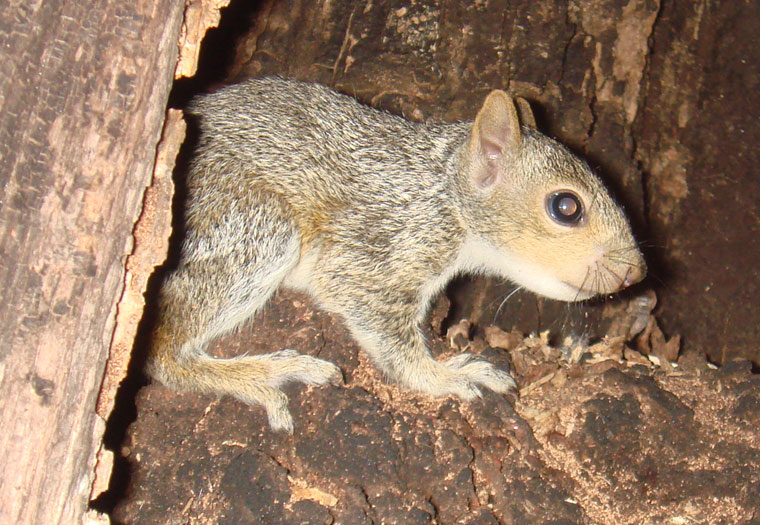
The gray squirrel, also known as the eastern gray squirrel, is actually a bit of a bully. In Europe, it has caused populations of red squirrels (the native ones) to decline rapidly, and the species is also known as a pest in many other places across the globe too, especially in the USA. The fact that this critter has managed to make its way around the world and, more than that, kind-of taken over just once again reinstates the fact that these animals are NOT animals that you should underestimate.
Although classed as the “bad guys,” squirrels are actually very good for the ecosystem, and this is mostly because of that food-stashing action. Squirrels will keep taking food from a food source, not just to eat, but also to store in a larder for later consumption. This is what enables them to make it through the hard times (winter) when there is very little food on offer elsewhere.
Squirrels have a pretty good sense of memory, but they do forget the locations of their stashes from time to time. They’re also pretty good at moving around with large amounts of food, fast and nimble critters that can climb a tree in less time than it takes for you to blink, but they drop bits occasionally too. An acorn here, a seed there, a nut somewhere else … These food morsels are not always snapped up by other animals — the acorns, seeds, nuts, etc. are then pushed into the ground and potentially sprout into a brand new tree or plant. It’s a little bit like how bees help to pollinate flowers — birds, squirrels, and a string of other animals are responsible for that “accidental" regeneration of plant life.
What do squirrels look like?
We all know what squirrels look like, so this question does seem a little obsolete. However … it must be taken into consideration that there are endangered species of squirrel that should be protected, rather than trapped or culled. You will face hefty fines and/or prison sentences for interfering with animals that are protected, especially if they are protected at a federal level.
The gray squirrel (or the gray eastern squirrel), despite the name, can be just as brown as it can be gray. You will usually find that the underside of the animal has slightly lighter colorings than the top side, and the critter also has the tail — the thing that squirrels are particularly famous for, which act as a fluffy bedtime coverup as much as it acts as a defence mechanism against predators.
Again, despite the name, shades of black have even been seen on eastern gray squirrels, particularly the more you move into Canada and similar regions. It is thought that colder conditions, urban environments, and lots of predators are behind the color-adaptation and is, once again, a sign that these animals will do everything they can in order to survive. Evolution is happening right in front of your very eyes!
Both male and female squirrels are pretty much the same kind of size, usually with a body length of 12 inches maximum, a tail about the same again when it’s laid out straight. The biggest of the eastern gray squirrel species can get to about 600g in weight.
What & how do squirrels eat?
We already know that squirrels stash away food for later consumption — this is one of those little tricks they have up their sleeves (or, rather, paws) that enables them to survive when the going gets tough. During the winter, for example, there is very little food easily found out ‘in the wild,’ but a food stash can be leaned upon.
Squirrels actually eat a wide and varied mix of foods, although, we usually associate them with just seeds, nuts, and berries. They will eat buds and bark of certain trees, nuts, acorns, seeds, fungi (mushrooms), particularly in forest areas, sweet fruits, such as strawberries, tomatoes, and in cases where it is absolutely necessary, the squirrels will also turn carnivorous, feasting on smaller mammals and insects. For the most part, squirrels are herbivores.
Where do squirrels live?
As we have previously discussed, eastern gray squirrels live all over the world, although, being tree squirrels, they do prefer to spend a lot of their times in areas that have plenty of trees. Where these animals don't have heavily treed areas left, they will resort to moving in with humans, in urban habitats, and this is when they will prey on residential and commercial buildings, usually in the attic.
In a perfect world, the squirrel would have plenty of trees for overhead cover from predators such as eagles, hawks, and owls, as well as plenty of foliage on the ground too, to protect them from ground-level predators — wolves, foxes, coyotes, raccoons, dogs, etc.
Dens are built in trees, on tree branches, in tree hollows, and in places along the ground, providing it is well protected. Bird nests that have been abandoned make easy homes, but the squirrel won't be undeterred if it has to build its own. Using feathers, grasses, moss, and other natural substances and materials, a squirrel will create a nest that is warm, safe, and sheltered.
Squirrels and their babies
Squirrels become sexually active at about a year old, although females experience the need to breed earlier on than their male counterparts. When a ready-to-go male is in the presence of younger, first-time squirrels, his hormones are said to induce breeding, and females as young as just six months of age can then mate. Read more about Squirrels in the Attic - Are There Babies Too?
Litters can vary greatly in size, depending on the age of the mother, as well as environmental factors. A really good number is eight, a good number is between three and five, one to four is about the average, but only a quarter of a litter will make it to sexual maturity. Many of them die at the hands of many causes before this point, starvation, dehydration, a trapped or killed mother, vehicle accidents, disease, predatory attacks, and other natural causes usually being the root cause.
The young will stay within the safety and comfort of their nest until they are about three or four months of age, and their mothers will then teach them the ways of the world.
In the very best conditions, squirrels can have two litters per year, although younger females are generally known to have just the one. They will breed in the spring, and if the weather is right and there is plenty of food about, they will also breed a second time, during the summer.
Go back to the Squirrel Removal page, or learn tips to do it yourself with my How to Get Rid of Squirrels guide.
Select Your Animal

RaccoonsRaccoon Removal Information & How-To Tips

SquirrelsSquirrel Removal Information & How-To Tips

OpossumOpossum Removal Information & How-To Tips

SkunksSkunk Removal Information & How-To Tips

RatsRat Removal Information & How-To Tips

MiceMouse Removal Information & How-To Tips

MolesMole Removal Information & How-To Tips

GroundhogGroundhog Removal Information & How-To Tips

ArmadillosArmadillo Removal Information & How-To Tips

BeaverBeaver Removal Information & How-To Tips

FoxFox Removal Information & How-To Tips

CoyotesCoyote Removal Information & How-To Tips

BirdsBird Removal Information & How-To Tips

BatsBat Removal Information & How-To Tips

SnakesSnake Removal Information & How-To Tips

DeadDead Animal Removal Information & How-To Tips

OthersOther Wildlife Species Information & How-To Tips