- info@wildlife-removal.com
Call us for help in your town
Wildlife Removal Education
Snake Removal and Control
Need snake removal in your hometown? We service over 500 USA locations! Click here to hire us in your town and check prices - updated for year 2021.
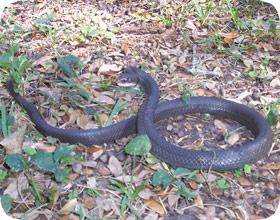 Snakes are usually classified as a pest species due to people's fear of the animal. The most common complaints include the following:
- Snakes in yard or on property
- Snakes living under home or deck
- Snake in the swimming pool
- Snake inside the home!
- Concern for safety of pets
SNAKE BIOLOGY:
There's too many snake species to catalogue here. Some facts common to all snakes -
they have no eyelids. They smell with their tongues, by flicking the forked tongue out and tasting the air with the Jacobsen's organ. They are carnivorous. Some give birth to live young, but most lay eggs. One myth about
snakes is that if a snake has a triangular head, it is poisonous (venomous). This is not true - most snakes have triangular heads. As reptiles, their body temperature is regulated by surrounding temperatures. Sometimes
they'll sunbathe to raise temperature. Many snake usually prefer to hide under heavy cover in cool areas. All snakes are strictly carnivores, and since they can't chew, they swallow their food whole. The poo and pee out
of the same hole. Since many
people ask me, I have posted some photos of what snake poop looks like.
SNAKE BEHAVIOR: The important thing to know is that most snakes are non-venomous, and pretty much none of them are aggressive. That is,
no snake will slither up to you and attack you. Most will run, and some will stand their ground, but if you leave the snake alone, it'll leave you alone. That's how it works for most animals. Snakes live in a wide variety
of habitats. Some are great climbers, some are aquatic. Most are very patient when it comes to catching prey - they sit still and silent for a very long time, then when a prey item is in reach, they strike! Some kill
by venom, some by constriction. Some just grab bugs and eat them.
NUISANCE CONCERNS:
The primary concern seems to be fear of snakes (Ophidiophobia) which many people have. It's a common phobia, and I've seen it many times. I've seen adults cowering up on chairs, shaking. It's irrational, but very
real for some people. Even for those without a flat-out phobia, snakes are often unsettling. Often it's just a matter of ignorance - people don't know which snakes are venomous and which are not, so they are naturally
cautious around all snakes. Snakes inhabit many ecological niches, and often around human buildings. They'll get into pools, screened porches, and oftentimes, the home itself. Snakes don't need much space to enter
a home.
Though not a common problem, I have here a page about how to get snakes out of the attic.
HOW DO I GET RID OF SNAKES?
If you've got a snake on your property, you might just want to leave it alone. It'll be on its way. If you see it habitually and don't like it, then you might want to have it removed. If you've got a snake inside your
house and you are unsure of the species, don't try to catch it - most cases of snake bite actually occur when a person is trying to kill or catch a snake. Leave it alone, or isolate it if possible. A wildlife control
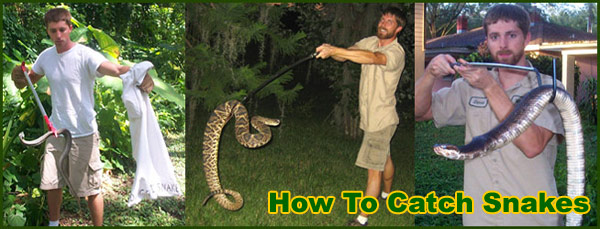
expert can come and remove the snake. For more info, read How to Catch Snakes. In addition, some
people are able to use snake traps to catch snakes. These traps
utilize a sticky pad, so if you use such a trap, be sure to spray cooking oil on the
captured snake to release it elsewhere. Perhaps the best way to get rid of snakes is with snake prevention. Eliminate the features on your property that attract snakes, such as excess debris, or gaps under concrete. I have more advice on this matter here:
How Do You Keep Snakes Away. If that's not enough for you, I have written eight tips for how To get rid of snakes.
SHOULD I KILL SNAKES?
You can read my thoughts on the subject here - How to Kill Snakes but in short, it is my advice that you do not kill snakes, for both their benefit and yours.
CAN'T I JUST USE A REPELLENT?
The effectiveness of snake repellents is often a hotly contested topic, but in my experience and in the experience of knowledgeable biologists and herpetologists, there is really no effective snake repellent.
It's probably better to leave snakes alone than to poison the environment by littering the ground with the various snake deterrents sold on the market. If you've got snakes in the home, the best bet is to identify and
seal shut any and all possible entry points. Read more about Do Mothballs Keep Away Snakes.
CAN I USE A SNAKE TRAP?
Yes you can. There are a few on the market, but I have found one brand that works best. Read about it here, on my How To Trap Snakes page.
HOW CAN I TELL IF A SNAKE IS POISONOUS?
Many people mistakenly assume that all snakes are poisonous - the correct term is "venomous", because snakes inject venom, whereas poison is a more generic term. The truth is that there's no easy way for amateurs to tell - so just leave all snakes alone! If you must know, your best
bet is to simply do a web search for the venomous snake species in your state, and memorize what they look like. Finally, with the exception of the red/black/yellow coral snake (learn the Color Rhyme for Coral Snakes), most venomous snakes in the USA are pit vipers, which are very fat snakes. So if it's a thin snake, it's
probably harmless. The pit vipers are all rattlesnakes (and all rattlesnakes are venomous!) or fat water snakes, like the cottonmouth or copperhead. Of course, harmless water snakes are also pretty thick, so it's hard to tell. And pretty much all snakes have triangular heads or patterns
of some sort, so there's no single trait that will determine if a snake is dangerous or not. Best bet - just leave all snakes alone if you encounter one. Most bites happen when people try to catch or kill snakes.
Full article here: How Can You Tell if a Snake is Poisonous.
WHAT SHOULD I DO IF I'M BITTEN?
First of all, if you were bitten by a venomous snake, it's most likely a pit viper - you'll have been punctured with large sharp fangs and immediately your flesh will start to dissolve - it'll be excruciatingly painful
and immistakeable. If you've just gotten a little nick from a harmless snake, you might actually bleed a lot, because snakes often have anticoagulants in their saliva. If it's not a pit viper, such as the red-yellow-black
Coral Snake, then you won't have the searing pain, since that's a neurotoxic venom. Anyway, here's what you should do - try to remember what the snake looked like. If you can safely gather the specimen, do so, but NOT at
the risk of receiving another bite! Call emergency services - an ambulance - if you think it's a venomous snake, or have a friend drive you to the hospital. Don't drive yourself, for risk that you'll pass out on the way.
Don't bother with tourniquets, cutting the bite and sucking poison, or any of that crap. It won't help. Read more about: Snakebite Aftercare. Avoid gettting
bitten beforehand, with my Snake Safety Tips Guide.
Here are photos of two venomous snakes that I caught: The Eastern Diamondback Rattlesnake and the Eastern Coral Snake. The first
is a hemotoxic (attacks tissue cells) pit viper, the second a neurotoxic (attacks nerve cells) elapid. Learn to identify and avoid both!
Click here for a nationwide list of 100's of professional snake experts serving all 50 states.
Or check out these select example cities:
Phoenix Snake Control -
Los Angeles Snake Control -
San Diego Snake Control -
San Jose Snake Control -
Denver Snake Control -
Orlando Snake Control -
Miami Snake Control -
Jacksonville Snake Control -
Atlanta Snake Control -
Chicago Snake Control -
Baltimore Snake Control -
Boston Snake Control -
Charlotte Snake Control -
Portland Snake Control -
Philadelphia Snake Control -
Houston Snake Control ...and
Australia Snake Control
Below I'll post an email from an astute reader of my websites, who has a
little more info on identifying snakes (for those who want to take a close look):
I found your website to be very informative, especially for the novice outdoors person. Since a very young age, I have always found snakes to be especially intriguing. Unfortunately it did lead me to be bitten by a Eastern Copperhead when I was about 10 years old. Fortunately I only spent 3 days in the hospital and survived with all my limbs and organs attached as they were originally.
Although I never furthered my interest in snakes into a career, I have always been very interested in learning more. I was glad to see your correction about the myths of identifying venomous snakes. I dont know how many times I have had to correct people about those myths. However, I feel that more detail should be added. There are two ways to be able to identify most venomous and non-venomous snakes. Both ways require much closer examination than the average person would like to have. I am sure that through your studies and career you have learned about the pupil differences between venomous and non-venomous snakes as well as the scaling differences from the anal gland to the end of the tail. Therefore I probably dont need to go into further detail. However, adding this information to your site could be very beneficial to some folks who especially have found themselves in tight situations with snakes. I have heard of several such occurrences, which usually involved people in boats in which snakes have either dropped out of trees into their boats or the snakes have crawled out from under a boat seat while the person was in the middle of a lake or swamp. Had they known how to correctly identify the snakes, there is a good chance that they would not have gone for an unexpected swim.
I just realized that my nephew, who lives in Baton Rouge, is listed on your website for Animal Removal. What a strange coincidence. I found your website by accident while I was searching for information on spaying our lab puppy. What a small world it is. I cant help to think that his interest in animals, especially wild animals, came from mine and my brothers own interests. We were both known as the snake catchers in our neighborhood.
Thank you for your website and I hope you have many more successful adventures with our wildlife friends.
Snake Email From Reader: Hello David, I live in Bartow Florida and have many black snakes that have lived here for years in my back yard. However, the other day a bunch of birds alerted me that someone was in the yard.
When I looked out, I saw a yellow snake. I usually just gently walk toward the black snakes if I need them to go and they go. When I went to identify the snake it became aggressive and coiled into
striking position.
It made a clicking almost like a rattle and warned me away, BIGTIME. The snake has a completely yellow head which was triangular, I believe. It had banding down the body, brown I think rectangular shaped. I thought it
was a corn snake, but now I think it may be someone's very aggressive Boa of some kind. It was probably four to five feet long, hard to tell. The head was not very big. I hope I have given you enough info to help identify it.
I have young grandchildren and my husband may kill it if he feels it is dangerous. It appears to be inside a concrete fire pit. I don't allow anyone to kill my black snakes, but am not sure about this one. Any help you can
provide would be greatly appreciated. If I can get a pic, I'll send it you. Sincerely, Jill *PHOTO ATTACHED*
My Response: It's a Yellow Rat Snake. It's a harmless and beneficial snake. I'd be happy to have it on my property. They are rarely aggressive,
so give it a chance and it'll calm down.
Thank you, David! Two more questions, please. Should I relocate it or just give it some space like I do my other snakes. Are they always this aggressive? It's practically living on my patio. Thanks, your website was very helpful.
If you give it space, it will probably move on. If not, and if you don't want it on your property, call a pro off of my directory, and they'll be able to remove it for you.
Some people ask me - What Animals Kill Snakes - so I wrote a guide about critters that do the snake removal for you!
Also read about:
About Snakes Information
What Should I Do With A Snake After I Catch It?
The Banded Water Snake
Select Your Animal

RaccoonsRaccoon Removal Information & How-To Tips

SquirrelsSquirrel Removal Information & How-To Tips

OpossumOpossum Removal Information & How-To Tips

SkunksSkunk Removal Information & How-To Tips

RatsRat Removal Information & How-To Tips

MiceMouse Removal Information & How-To Tips

MolesMole Removal Information & How-To Tips

GroundhogGroundhog Removal Information & How-To Tips

ArmadillosArmadillo Removal Information & How-To Tips

BeaverBeaver Removal Information & How-To Tips

FoxFox Removal Information & How-To Tips

CoyotesCoyote Removal Information & How-To Tips

BirdsBird Removal Information & How-To Tips

BatsBat Removal Information & How-To Tips

SnakesSnake Removal Information & How-To Tips

DeadDead Animal Removal Information & How-To Tips

OthersOther Wildlife Species Information & How-To Tips