- info@wildlife-removal.com
Call us for help in your town
Wildlife Removal Education
Skunk Removal and Control
Need skunk removal in your hometown? We service over 500 USA locations! Click here to hire us in your town and check prices - updated for year 2021.
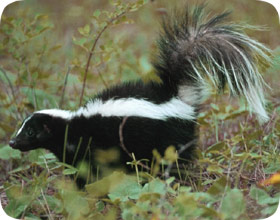 Skunks are usually classified as a pest species due to their odor, and
occasionally, digging. The most common complaints include the following:
Skunks are usually classified as a pest species due to their odor, and
occasionally, digging. The most common complaints include the following:
- Skunk is living under deck or porch
- Skunk has sprayed in the vicinity
- Skunk has sprayed a pet dog
- Skunks are digging holes in yard
- Skunks fell down window well/basement
SKUNK REMOVAL:
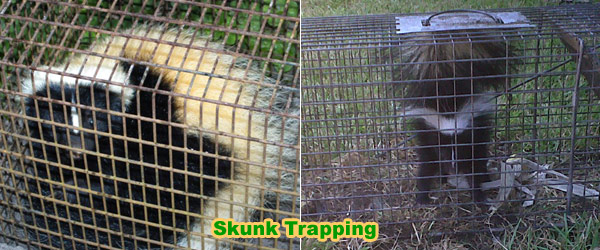
Your best bet is to trap the skunks in live cage traps, and relocate them. It's actually pretty easy to do, and safer and more effective than trying to kill the skunks. You may be
worried about the skunk spraying you, but it's really easy to avoid that. And just so you know, there is absolutely no skunk repellent spray (ironic!) powder, or device that'll keep them away. But if you
trap them and relocate them at least five miles from your property, that should solve the problem. You can either hire a professional to do so for you (laws may prevent you from doing it yourself anyway) and that
way you don't have to worry about getting sprayed, and if you want to try to do it yourself, I have written a full guide which you can read on how to trap skunks here. If the
skunk has fallen down a window well or basement, you can have a pro snare if for you, or you can put a wooden board down the window well, and the skunk should be able to climb out.
SKUNK PREVENTION:
Of course,
you can help prevent skunks from using your property. They are often drawn to live under decks, porches, sheds and such. You need to install an exclusion barrier around the perimeter of the deck, so that
they can't crawl under. And of course, don't leave out pet food, or any other food that will attract skunks. If you want to hire a professional wildlife trapper to trap the skunks or install a professional
exclusion barrier for you, click on this nationwide map of Professional Wildlife Removal Companies, and you'll find an expert in your town or city.
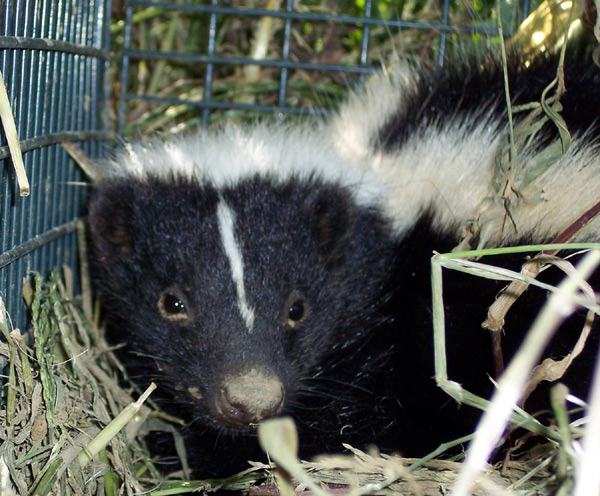
SKUNK BIOLOGY: The Striped Skunk (Mephitis mephitis) weighs from 4-10 pounds and is 24-30 inches long. Skunks are easy to recognize with their distinct black and white coloring. The Striped Skunk has two
white bands that run from the head and down each side of the back. They do not form long partnerships, and mate in late February, and young are born in May. A litter may be five or six young. They follow the
mother around, and after they are a year old, they depart to live on their own. Most die during their first winter. They usually only live 2-4 years in the wild, but can live more than a dozen years in captivity.
There are other skunk species as well, such as the Eastern Spotted Skunk (Spilogale putorius) which is smaller but similar in behavior. These skunks will actually perform a handstand when spraying.
SKUNK BEHAVIOR: Skunks are mostly nocturnal, and forage at night for a variety of foods. The are omnivores, eating both plant and animal matter, but really seem to prefer insects. They sleep during the day,
usually in underground dens often dug by other animals. They do not fully hibernate, but activity is very low during the winter. The often communicate via scent marking, and males will often discharge during mating
season. Skunks are well-known for their defensive tactic - when threatened, they will arch their back, lift the tail, and discharge a highly odiferous liquid from special glands near the anus. This sulphurous compound
is not only offensive to the nose, but it can cause temporary blindness in an attacker. Many animals avoid skunks due to this defensive tactic, and it's actually often birds like hawks and owls that prey on skunks,
since these birds lack a sense of smell.
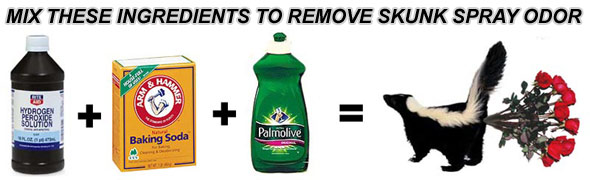
HOW DO I GET RID OF SKUNK SMELL? If you or your pet (usually a dog) is sprayed by a skunk, don't bother with the old tomato juice bath. It doesn't help. The best way to get rid of the smell is to combine hydrogen
peroxide, baking soda, and liquid dish soap, and immediately shampoo the dog (or
person) with that. If sprayed in the eyes, flush them with water.
NUISANCE CONCERNS:
One of the largest concerns is the odor. Skunks very frequently inhabit human dwellings. They'll live under sheds, porches, decks, etc. Read about skunk under a shed, porch, or deck They may discharge or scent mark these areas, creating an unpleasant odor. Many
people don't like skunks on the property, because of fear of stumbling across one and getting sprayed. There's also the matter of pet/skunk conflict. Skunks often fall down basement window wells as well. In addition,
they can actually do a lot of digging, and damage a lawn.
SKUNK DISEASES:
Skunks are frequent carriers of rabies. I don't know if they carry any other diseases that humans or pets can get. Here is a complete analysis of skunk diseases.
HOW DO I GET RID OF SKUNKS?
The best method is to trap and remove the skunks from the area. Skunk trapping can be tricky, due to the animal's ability to spray. Some trappers use solid-walled traps for this reason. Others make sure to drape
the trap with a sheet or towel prior to transportation. You can try a variety of techniques. Here is my full analysis, a how-to for how to get rid of skunks
CAN'T I JUST USE A REPELLENT?
There is no registered or effective skunk repellent available. You can find some products on the market, such as mothball-based or urine-based repellents, but they are bogus. Go ahead and try them. And those high-pitch
noisemakers, also called ultrasonic sound emitters, do not work. There is no quick and easy fix when it comes to skunk removal and control. You can try various tactics to keep skunks away
It's best to have a professional trap and remove the animals properly.
Click here for a nationwide list of 100's of professional skunk trappers serving all 50 states.
Phoenix Skunk Control -
Los Angeles Skunk Control -
San Diego Skunk Control -
San Jose Skunk Control -
Denver Skunk Control -
Chicago Skunk Control -
Baltimore Skunk Control -
Boston Skunk Control -
Minneapolis Skunk Control -
Charlotte Skunk Control -
Portland Skunk Control -
Philadelphia Skunk Control -
Houston Skunk Control -
Seattle Skunk Control
Also read:
About Skunks: Biology Information
Do Skunks Attack Pets?
Do mothballs and ammonia help repel skunks?
What should I do with a skunk after I catch it?
Should I feed a baby skunk I found?
What should I do if I find an orphaned baby skunk?
What should I do if I find a nest of baby skunks?
Do Baby Or Juvenile Skunks Spray?
What is the best bait to trap a skunk?
Is it Safe to Handle a Skunk with Bare Hands?
Do Skunks Burrow Underground?
Do Skunks Attack Chickens?
Is a skunk that is active during the day time rabid?
How to find and remove a dead skunk
What is a skunk's natural diet?
Why do skunks dig?
What equipment is needed to trap a skunk?
Is skunk feces dangerous to touch or breathe?
Do Skunks Fight Each Other?
How to use one-way exclusion funnels to remove skunks
How to keep skunks out of my garage
How to keep skunks out of my garbage cans
Where do skunks live?
What are some humane ways to kill a skunk in a trap?
What if a skunk got inside my house?
Will the city or county animal services help with a skunk issue?
What is a skunk's mating habits?
Do Skunks Come Out During The Day?
Will a pest control company help to remove skunks?
Do Skunks HIbernate During the Winter?
Are Skunks Good Pets?
When Do Skunks Shed Their Fur?
Best Ways to Remove Skunk Smell From Your House or Car
Is A High Pitch Sound Deterrent Machine Useful Against Skunks?
How Should You Remove Skunk Smell From Your Dog, Car, or House?
Best Ways To Protect Yourself From Skunk Sprays
Can A Skunk Spray Multiple Times At Once?
Can Skunks Swim?
Why Skunks Spray
Skunk Email From Reader: Hi David, I came across your website last night when one of my dogs came home after being sprayed by a skunk. We also think we saw some skunk droppings
in our yard. My husband let her in the door and she started
running around the house and rubbing herself on the dog beds and all over my carpets. I bathed her in the solution that you recommended and she seems to be much better. However, the smell is
terrible in my house. I am not sure what I can do and how to treat all of the surfaces from the wood floors to carpets. I really don't know everything she has touched or if the smell will
dissipate over time. Can you recommend a course of action? I am in Arizona, in the NW corner of the state. There is not a business in my area that handles these sorts of skunk extermination things. I haven't had a
skunk around in over a year. They usually don't hang around because of all the animals we have. I live in mountains and wildlife is part of our daily life. This particular skunk has been hanging
around for a couple of weeks. I think it made itself at home while I had a house sitter when I was on vacation for the last 2 weeks. I came home 2 nights ago and it was on my front porch. I thought
it was one of my cats, because it did not have a large white stripe, but when it ran off I knew immediately from it's body that it was a skunk and probably a young one. I have moved our animal feeders
and changed feeding time. We pick up bowls and do not leave anything out. I think there was dry food spillage that attracted the animal while I was away. We sweep everyday and know not to leave any morsels
for wildlife. We even pulled down bird feeders last year because they attracted skunks. Please let me know your thoughts. Thank you, Teri (stinky in AZ)
My Response: Well first of all, regarding the skunk odor, you can mix the baking soda, dishwashing soap, and hydrogen peroxide and wash some surfaces with it. I don't know if it damages cloth or not, so maybe do a test spot. As far as the skunk
problem, you can hire one of my trappers in Arizona to trap and remove the skunk for you.
Skunk Email From Reader: Gentlemen, I would first like to thank-you for presenting an easy to read, informative web site. Your attention to detail is
phenomenal.
That said, I feel you would like to know that our dog was sprayed by a skunk, while tied outside. He had no way of escaping that "perfume". No one was remiss
in reading the clear signs that skunks give before they spray. I just thought that it is better to know all sides of a situation before blame is handed out on a poor dog, which I felt was your intention on the web page for the skunk odor removal recipe.
As I mentioned, your presentation was so nice, I didn't think you would want to sully it with negativity. This is just an observation, thought you'd appreciate it. With Thanks, Sandy
My Response: Ha ha ha! When I said that a dog should learn to read the signs of a skunk that's about to spray, I was kidding! Dogs never learn! Good one!
Select Your Animal

RaccoonsRaccoon Removal Information & How-To Tips

SquirrelsSquirrel Removal Information & How-To Tips

OpossumOpossum Removal Information & How-To Tips

SkunksSkunk Removal Information & How-To Tips

RatsRat Removal Information & How-To Tips

MiceMouse Removal Information & How-To Tips

MolesMole Removal Information & How-To Tips

GroundhogGroundhog Removal Information & How-To Tips

ArmadillosArmadillo Removal Information & How-To Tips

BeaverBeaver Removal Information & How-To Tips

FoxFox Removal Information & How-To Tips

CoyotesCoyote Removal Information & How-To Tips

BirdsBird Removal Information & How-To Tips

BatsBat Removal Information & How-To Tips

SnakesSnake Removal Information & How-To Tips

DeadDead Animal Removal Information & How-To Tips

OthersOther Wildlife Species Information & How-To Tips